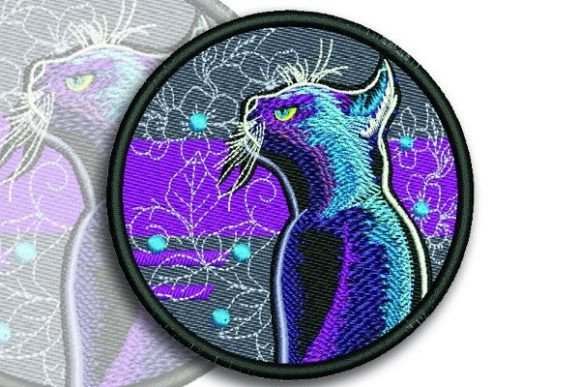
Cat in Circle: A Designer’s Real-World Embroidery Review
First Impressions: Charm Without Clutter
When I opened Cat in Circle for the first time, what struck me wasn’t just the cuteness—it was the quiet confidence in its simplicity. The cat sits centered inside a clean, unbroken circle, tail curled just so, ears perked, eyes soft but expressive. It’s not overly detailed, but it’s never vague. There’s no fussy outlining or excessive satin stitching—just balanced fill stitches, gentle curves, and intentional negative space. This isn’t a design shouting for attention; it’s one that earns it through thoughtful composition. For a craft business or Etsy seller building a cohesive brand around warmth and authenticity, Cat in Circle feels like a natural signature—not a trend-chaser, but a keeper.
Real Project Test: Stitching It on a Linen Tea Towel
Last week, I used Cat in Circle on a set of heavyweight linen tea towels for a local boutique launch. No appliqué, no background fill—just the design alone, 3.8" wide, stitched in matte cotton thread on natural off-white fabric. The result? Instant recognition. Customers paused mid-aisle. One said, “It looks handmade—but *intentionally* so.” That’s the sweet spot: Cat in Circle reads as both approachable and refined. The circle frame gives structure, the cat adds personality, and the stitch density (moderate, not heavy) kept the towel supple—not stiff or plasticky. It held up beautifully after three test washes, with zero fraying or puckering.
Where It Shines—and Where to Pause
Cat in Circle is exceptionally versatile across common embroidery projects:
- Custom apparel: Works cleanly on crewneck sweatshirts (left chest), relaxed-fit t-shirts (back yoke), and structured caps (front panel)—as long as you use cutaway stabilizer and adjust tension for knit fabrics.
- Baby and nursery items: Ideal for onesies, burp cloths, and pillow covers. Its rounded shape avoids sharp corners that could irritate delicate skin.
- Patches and tote bags: Holds crispness at 4–5" sizes. On canvas totes, it reads clearly even from across a craft fair table.
- Holiday and gift embroidery: Paired with subtle seasonal accents—like a tiny embroidered bow beside the circle—it becomes a quiet heirloom piece, not a themed gimmick.
That said, proceed with care on:
- Thin or sheer fabrics (e.g., lightweight rayon or voile)—the fill stitch coverage may show backing unless you add tear-away + iron-on stabilizer.
- Highly textured surfaces (like bouclé or thick terry cloth)—test stitch first; the circle outline can blur if stitches sink between fibers.
- Curved or tight-radius areas (e.g., baseball cap crowns)—scale down to ≤3.2" and confirm hoop clearance before committing.
- Dark fabrics with light thread—check how the satin-stitched eyes hold contrast. Sometimes switching to tonal gray instead of stark white keeps the expression soft and legible.
What It Adds to Your Finished Product—Beyond Cute
As a designer who ships hundreds of embroidered goods yearly, I pay close attention to how a machine embroidery design affects perceived value. Cat in Circle consistently lifts the professionalism of the finished product—not because it’s flashy, but because it’s resolved. There are no ambiguous lines or muddy corners. The circle acts like a visual anchor, making alignment easy on irregular surfaces (think curved apron pockets or uneven pillow seams). For Etsy sellers, that means fewer “Is this centered?” questions and more five-star reviews about “perfect stitching.” For small shop owners, it reinforces brand consistency: whether on a ceramic mug sleeve or a baby blanket tag, Cat in Circle feels like part of a family—not a one-off graphic.
Practical Designer Notes You’ll Actually Use
Before stitching Cat in Circle into your next project, here’s what I do—every time:
- Test on scrap fabric that matches your final substrate, using the same needle, thread, and stabilizer combo.
- Review stitch density visually in your embroidery software—look for any dense clusters near the cat’s face or paws that might cause stiffness or thread breakage.
- Confirm hoop size compatibility. If you’re working with a 4×4 hoop, verify the largest version fits comfortably with ⅛" margin.
- Inspect small details in black-and-white mockups—especially the eyes and ear tips—to ensure they translate clearly on dark backgrounds.
- Check thread color contrast across at least two fabric tones (light and medium-dark) before finalizing your palette.
- Verify licensing if you plan to sell physical items or digital embroidery files. Some versions of Cat in Circle allow commercial use; others don’t—always double-check before listing on Etsy or bundling into design assets.
A Design That Grows With Your Business
I’ve used Cat in Circle in ways I didn’t expect at first: as a subtle logo on woven labels, scaled down for charm bracelets, and even digitized into a minimalist iron-on patch for a kids’ clothing line. Its strength lies in flexibility without compromise—no detail feels sacrificed, no shape feels forced. It doesn’t dominate a garment; it belongs there. For embroidery designers and creative entrepreneurs, that’s rare. It’s the kind of machine embroidery design that quietly builds trust: with customers who recognize quality in restraint, with collaborators who appreciate clean file structure, and with yourself—the maker—who knows this isn’t just another download, but a reliable tool in your craft business toolkit.