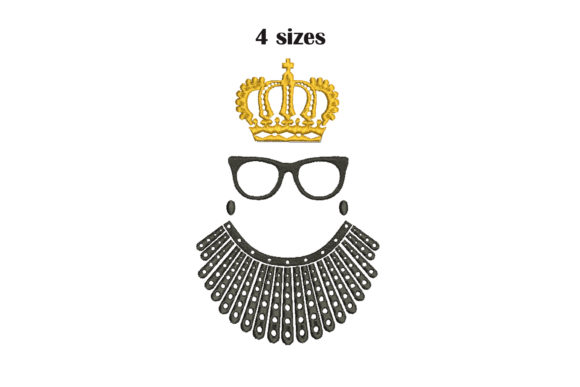
Ruth Bader Ginsburg Embroidery
First Impression: Bold, Empowering, and Instantly Recognizable
As an embroidery designer who’s prepped over 200 craft fair booths—and shipped thousands of embroidered tote bags, tea towels, and patches—I’ll say it straight: Ruth Bader Ginsburg lands with quiet authority. It’s not cute. Not rustic. Not festive or minimalist. It’s bold, elegant, and deeply human—exactly what makes it a standout in the Awareness category. The description—“for every woman, every girlfriend, every mother, and daughter… for all women who believe in themselves”—tells me this isn’t just text stitched on fabric. It’s a statement piece. Customers pause. They smile. They point. That’s gold at a crowded handmade market.
Where Ruth Bader Ginsburg Shines On Craft Fair Products
This machine embroidery design thrives where intention meets utility:
- Tote bag design: Centered on a natural canvas or linen tote? Perfect. Large enough to read from three feet away, yet refined enough to avoid shouting. Ideal for booth signage and impulse buys.
- Apron embroidery: Left-chest placement reads beautifully—especially on denim or heavyweight cotton. Adds gravitas to kitchen wear without sacrificing warmth.
- Tea towel embroidery: Works best on medium-weight, tightly woven cotton (not terry). The name carries weight, so clarity matters—avoid overly textured surfaces that blur letterforms.
- Embroidered patch: A top-tier option. Iron-on or sew-on, it lets customers personalize jackets, bags, or denim—making Ruth Bader Ginsburg portable, shareable, and repeat-purchasable.
- Caps and fabric pouches: Use only if the embroidery file includes a simplified or condensed version. Full-name layouts rarely translate cleanly to curved cap fronts or 3” x 4” pouches without losing legibility.
- Pillow covers and market bags: Strong focal point. Especially effective on neutral backgrounds—cream, charcoal, oat, or deep navy—where thread contrast lifts the design naturally.
What Makes This Design Sell—And What Slows It Down
At a craft fair, attention is currency. Ruth Bader Ginsburg earns it fast: no decoding required, no trend-chasing, no inside jokes. It’s instantly legible, emotionally resonant, and photogenic. As an Etsy seller or small shop owner, you’ll find it converts well in listings paired with strong printable mockups—especially lifestyle shots showing the design on a worn-in apron or a hand-stitched pillow cover.
But realism matters. This isn’t a one-size-fits-all handmade product. Its strength lies in medium-to-large applications. On a 2” patch or tiny keychain pouch? It risks becoming fuzzy or unreadable unless the digital embroidery file offers scalable variants. Likewise, dense stitch areas—especially around serifs or tight letter spacing—can cause puckering on lightweight fabrics or stiffen delicate linens. Always test.
Production Notes Every Embroidery Designer Should Check
Before cutting your first stabilizer sheet, ask yourself:
- Does the embroidery file include multiple sizes? You’ll need at least one optimized for 4x4 hoops (patches, pouches) and another for 5x7+ (totes, aprons, pillows).
- What’s the stitch density? High-density fills may overwhelm tea towels or thin cotton—opt for lighter underlay and reduced fill angles if possible.
- Are thread colors specified? Contrast is non-negotiable. On dark fabric, white or metallic silver pops. On light fabric, charcoal gray or navy adds sophistication without glare.
- What stabilizer works best? Tear-away for stable wovens (totes, aprons); cut-away for knits or stretchy blends; fusible + tear-away hybrid for towels.
- Have you mocked it up on your actual production fabric? A commercial embroidery sample on real tea towel texture—not just a swatch—reveals how lettering holds up under washing and use.
Careful-Use Notes: Protect Your Booth & Reputation
This design demands thoughtful execution:
- Avoid tiny lettering on curved surfaces—caps and rounded pouches distort fine details. If your file lacks a cap-optimized version, skip it.
- Don’t embroider directly onto heavily textured towels—the loops swallow fine stitching. Pre-press and use extra stabilizer—or choose flat-weave alternatives.
- Dark fabric requires high-contrast thread. Off-white or ecru won’t read. Test before batch production.
- Small shop product margins shrink fast if you re-hoop repeatedly due to misalignment or thread breaks. Confirm hoop size compatibility and digitizing quality upfront.
- Commercial licensing is essential. Since this is marketed as a machine embroidery design for resale, verify rights before selling finished goods—especially on platforms like Etsy that enforce IP policies strictly.
Why Ruth Bader Ginsburg Strengthens Your Booth—and Your Brand
In a sea of florals and quotes, Ruth Bader Ginsburg signals clarity of voice. It tells shoppers you curate meaningfully—not just decoratively. It pairs effortlessly with other Awareness-aligned pieces (voting rights, education, equity themes), building cohesion across your display. Buyers engage more: they ask questions, share stories, tag friends. That’s how a single embroidery file becomes a conversation starter, a gift recommendation, and a repeat customer anchor.
It also elevates perceived value. A simple linen tote with Ruth Bader Ginsburg stitched cleanly reads “thoughtful handmade,” not “craft fair filler.” That perception justifies premium pricing—and supports your long-term positioning as a boutique maker, not just a vendor.
Final Thought: Start Small, Scale With Confidence
Don’t try to launch ten craft fair product SKUs at once. Begin with two: a set of three tea towels and a stack of matching patches. Run them through your full workflow—hoop, stabilize, stitch, photograph, price, display. See how people respond. Then expand to aprons or pillow covers. Let Ruth Bader Ginsburg earn its place in your lineup—not as a hopeful experiment, but as a proven, resonant, beautifully executed handmade product.